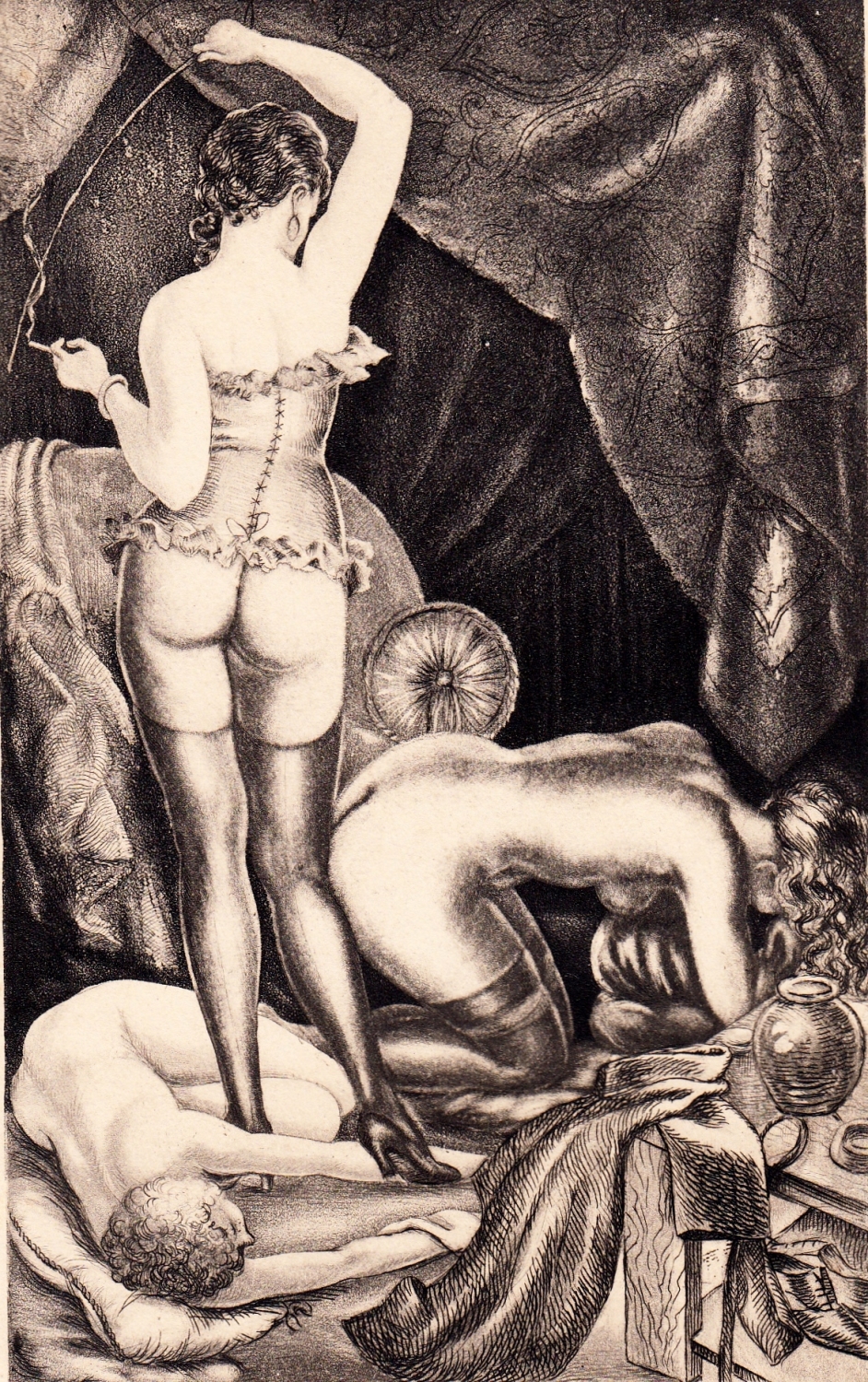
The scene is instantly recognizable to anyone familiar with 1930s Parisian livres galants. A corseted dominatrix stands like a dark Venus, one hand raised with a whip, the other resting on a curtain that frames her like a proscenium. At her feet: a kneeling man, head bowed, and a woman (the focal point) sprawled in surrender. The backdrop is heavy with symbolism: a shattered vase, a mirror reflecting nothing, drapery that swallows light. This is not mere erotica; it is theater of power.
But beneath the shared architecture, two distinct voices emerge, or it was meant to look that way.
Let’s take a closer look at the artworks from Davanzo and Wighead (who might have been the same artist).

Wighead: Devotion in Crimson and Gold
Wighead takes the same moment and flips it, literally.The woman now lies on her stomach, head bowed low, arms stretched forward in prostration. She is awake, aware, offering. This is not defeat, it is worship. The shift from supine to prone transforms her from victim to acolyte. She is no longer the conquered; she is the convert. Color is Wighead’s rebellion. Crimson leather gleams on the dominatrix’s corset. Gold threads catch the light in the kneeling man’s hair. The shattered vase becomes amber glass, the drapery a deep burgundy. The scene is no longer a morgue: it is a chapel of desire, lit by the glow of consent.
Davanzo: Conquest in Black and White
In Davanzo’s original engraving for L’Éducation de Chérubin (1934), the woman lies on her back. Her head is turned away, eyes closed, arms limp along the floor. She is absent, not just physically, but emotionally. This is submission as collapse: the body spent, the will extinguished. The dominatrix’s heel presses into the small of the kneeling man’s back, but the real victory is over the woman—reduced to a beautiful corpse in the tableau of dominance. Davanzo’s linework is surgical. Shadows are inky voids; highlights are razor-thin. There is no warmth, no invitation. The scene feels post-coital, post-violent, like the aftermath of a ritual sacrifice. The woman is not participating, she is evidence.
One Artist, Two Masks?
The similarities are too precise to ignore. The dominatrix’s stance, the angle of the whip, the placement of the mirror, every element aligns. Yet the emotional register is night and day.
Could Davanzo and Wighead be the same hand wearing different gloves?
Some collectors believe so. The pseudonym “Wighead” appears only in colored editions of Jean Fort’s flagellation novels, often reworking Davanzo’s plates. The timing fits: Davanzo’s black-and-white engravings were printed first, then hand-colored (or reinterpreted) for deluxe editions. The shift in the woman’s pose might not be artistic evolution, it could be commercial adaptation: monochrome for the purists, color (and active submission) for the fantasists.
The Woman on the Floor: A Mirror of Desire
Ultimately, she is the Rorschach test of the scene.
- To Davanzo, she is what power leaves behind.
- To Wighead, she is what power creates.
One sees submission as annihilation. The other sees it as ascension. And in that single flipped pose (back to belly, absence to presence) lies the entire philosophical chasm between erotic violence and erotic faith.